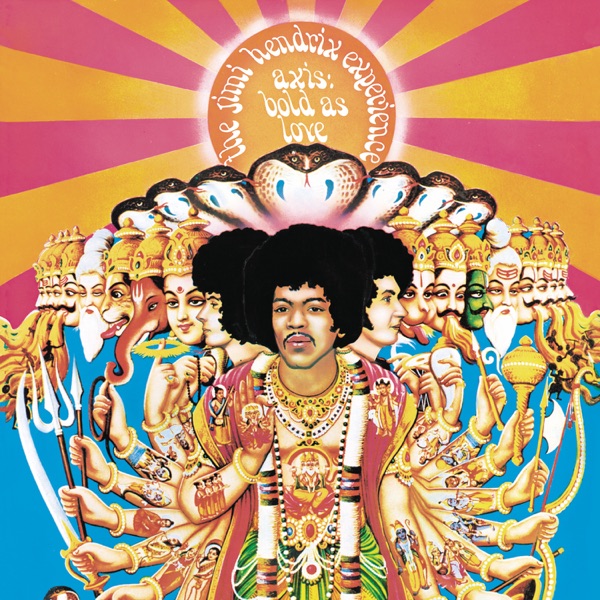
How to play Little Wing
Jimi Hendrix
Eight chords, Em, G, Am, Bm, Bb, C, F and D, strummed 24 times at 62 BPM. The record is in Eb standard, so tune every string down a half step to play along. Each shape is drawn out below with the whole sequence, then how to practice it with Lark.
Free, in your browser. Sign in, allow the mic, and Lark listens as you play.
The chords
Eb standard
The big names are the chords in the order you strum them. On the six lines below, each chord sits on the string its lowest note is played on. Tune every string down a half step first, so the frets sound like the record.
Read it chord by chord
- Em strum (sounds Ebm), lowest note on the open low Eb string
- G strum (sounds Gb), lowest note on the low Eb string, fret 3
- Am strum (sounds Abm), lowest note on the open Ab string
- Em strum (sounds Ebm), lowest note on the open low Eb string
- Bm strum (sounds Bbm), lowest note on the Ab string, fret 2
- Bb strum (sounds A), lowest note on the Ab string, fret 1
- Am strum (sounds Abm), lowest note on the open Ab string
- C strum (sounds B), lowest note on the Ab string, fret 3
- G strum (sounds Gb), lowest note on the low Eb string, fret 3
- F strum (sounds E), lowest note on the low Eb string, fret 1
- C strum (sounds B), lowest note on the Ab string, fret 3
- D strum (sounds Db), lowest note on the open Db string
- Em strum (sounds Ebm), lowest note on the open low Eb string
- G strum (sounds Gb), lowest note on the low Eb string, fret 3
- Am strum (sounds Abm), lowest note on the open Ab string
- Em strum (sounds Ebm), lowest note on the open low Eb string
- Bm strum (sounds Bbm), lowest note on the Ab string, fret 2
- Bb strum (sounds A), lowest note on the Ab string, fret 1
- Am strum (sounds Abm), lowest note on the open Ab string
- C strum (sounds B), lowest note on the Ab string, fret 3
- G strum (sounds Gb), lowest note on the low Eb string, fret 3
- F strum (sounds E), lowest note on the low Eb string, fret 1
- C strum (sounds B), lowest note on the Ab string, fret 3
- D strum (sounds Db), lowest note on the open Db string
Plain text tab
Eb standard

Em  G   Am  Em  Bm  Bb  Am  C
G   F   C   D   Em  G   Am  Em
Bm  Bb  Am  C   G   F   C   D
The shapes
Em
4 strums, sounds Ebm
G
4 strums, sounds Gb
Am
4 strums, sounds Abm
Bm
2 strums, sounds Bbm
Bb
2 strums, sounds A
C
4 strums, sounds B
F
2 strums, sounds E
D
2 strums, sounds Db
- Tuning
- Eb standardTune every string down a half step: Eb Ab Db Gb Bb eb
- Chords
- Em G Am Bm Bb C F Deight shapes, sounding Ebm Gb Abm Bbm A B E Db
- Chord changes
- 23in 24 strums
- Strummed most
- Em4 times
- Tempo
- 62 BPM31 BPM at half speed
How to practice it
Practice mode in Lark slows the song down and loops the part you keep missing, while it listens to every chord.
Start slow
Practice mode plays the click at 0.5x (31 BPM), 0.75x (47 BPM) or 1x (62 BPM). Stay at half speed until you stop missing, then step up.
Loop the hard part
Set a loop around any stretch of strums and it repeats until you have it. A good first loop: strums 1 to 4, the busiest stretch in this tab (Em, G, Am, Em).
Play it and watch the score
Lark listens through your mic for each chord as you strum it. Every chord turns green when you hit it and red when you miss, your accuracy updates as you go, and you see if you came in on the beat, late or slow.
Read the coach's note
When the song ends, the AI coach reads your run and gives you one specific thing to fix before the next one.